


 English
 Español

Amy Lou
Tel: +86-13750976592(whatsApp / Wechat)
E-mail: [email protected]

Earrings may look small, yet their shapes can vary dramatically. Studs have short posts and compact backs, hoops rely on circular profiles and closure points, while drop earrings may extend several centimeters below the ear wire. Such differences make the interior structure an important part of custom earring boxes.
Using the same insert for every earring style can create unnecessary movement, poor presentation, or insufficient clearance. A practical packaging design starts with the geometry of the actual jewelry and then develops the holding method around it.
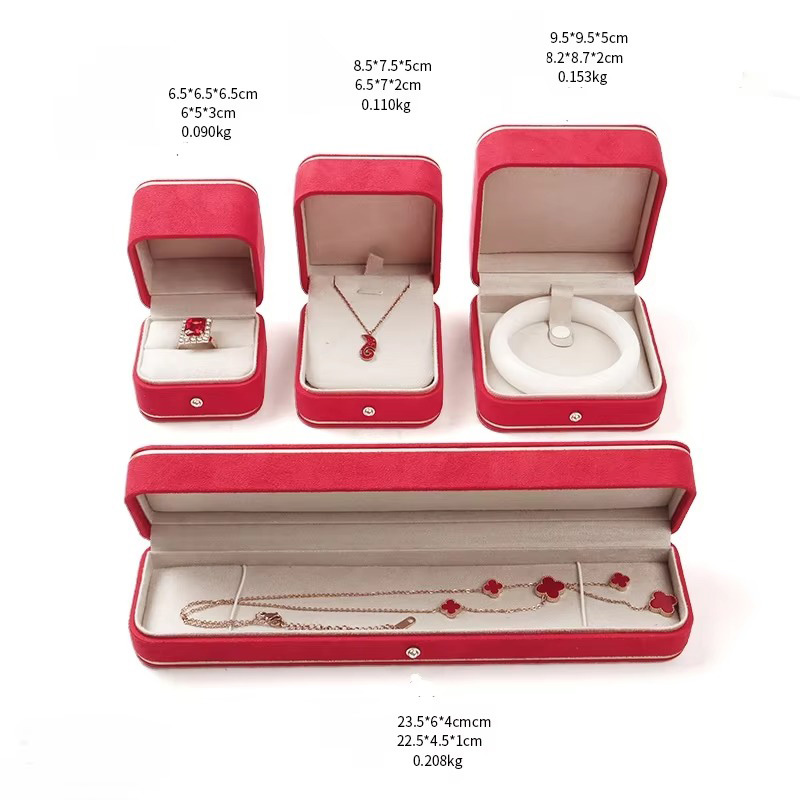
Stud earrings normally sit close to the presentation surface. Their posts pass through small holes or slots, while the backs remain behind the insert. This arrangement keeps the pair facing forward and reduces unwanted rotation.
Some current packaging specifications use small foam pads with twin holes for stud pairs. Reference dimensions around 50 × 50 × 30 mm internal space are also used for compact stud presentations, although the actual size depends on the jewelry dimensions and insert thickness.
Hoop earrings create a different packaging challenge. The outer diameter, wire thickness, clasp position, and overall profile determine how much room the insert requires.
Custom earring boxes designed for hoops need enough lateral space to accommodate the full circular shape. A tight cavity may press against the hoop or interfere with its closure, while excessive space allows the pair to move during transportation.
Reference packaging specifications show increasing internal box dimensions as hoop diameter grows, with examples ranging from approximately 50 × 50 × 25 mm for small hoops to around 110 × 110 × 40 mm for larger styles. These figures should be treated as design references rather than universal sizes.
Long drop and dangle earrings create a different issue: height. Their decorative sections may extend well below the hook or post, making shallow boxes unsuitable.
A suitable insert needs to keep the upper fastening point stable while allowing the lower decorative section to remain suspended or positioned without sharp bends.
Some packaging references place drop earrings in boxes around 75 × 75 × 45 mm internally, while longer designs may require additional depth. The actual requirement depends heavily on the total hanging length.
Packaging design often focuses on what the customer sees, yet the hidden side of an earring insert can affect the final fit. Stud backs, butterfly clasps, silicone backs, and other components need their own clearance.
Custom earring boxes can use different rear structures to accommodate these components without pushing the jewelry away from the presentation surface.
Such structures can keep both earrings aligned while making the backs easier to access during removal.
Different insert materials provide different levels of support. Foam can grip small posts and provide cushioning, while velvet or flocked surfaces create a softer visual presentation. Cotton-filled structures offer another approach for lightweight jewelry.
Material thickness should correspond with the earring weight and holding method. A thick insert is not automatically better; excessive thickness can reduce usable box space and make compact packaging unnecessarily bulky.
Jewelry collections may contain studs, small hoops, large hoops, and drops under the same packaging program. Using separate inserts can provide a precise fit for each style, while a shared outer box footprint can maintain visual consistency across the collection.
Another option is a multi-format insert that supports several approved earring shapes. Such an approach requires careful testing because the spacing needed for a stud can be very different from the clearance required by a large hoop or long drop.
Actual jewelry samples should be placed inside prototype inserts before production. Digital dimensions provide useful guidance, but physical testing reveals issues such as post pressure, clasp interference, unwanted movement, and difficult removal.
Custom earring boxes work better when the insert is developed around the actual earring shape rather than treating every pair as the same product. Studs require post support, hoops need diameter clearance, and drop earrings depend heavily on vertical space.
The outer box may create the visual identity, but the insert determines how the jewelry sits, moves, and appears after opening. Matching these two elements can create packaging that protects the product while presenting each earring style in a more controlled way.
5F, Building 1, No#8, Jiangwan Street, Yiwu City, Zhejiang Province, China, 322000 CN
